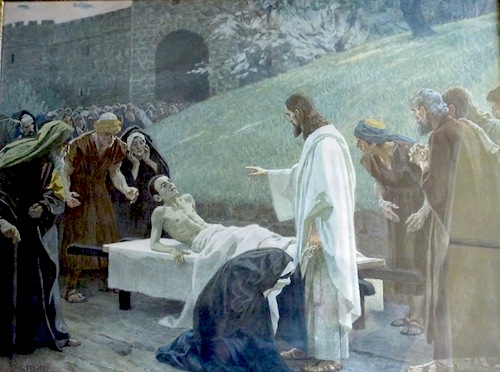
Based on Luke 7:11-17
An only son, a grieving mother,
A reflection and foreshadowing,
Jesus moved to tears,
Your grieving will stop here.
The sleep of death,
Cannot hold the son, or the Son,
Young man, arise,
Open up your eyes.

The mother’s heart soars,
From depths of pain untold,
Behold your mother,
My beloved, my brother.
The crowd seized with fear,
How can this be?
Countless hearts are stirred,
Restoring life with just a word.
This teacher is a prophet,
With powers heard of old,
Is He Elisha or Elijah,
Or could He be the Messiah!?
An only Son, a grieving mother,
The scene will play again,
This prophet is the Lord,
Destroying death and sin.
My Explanation of the Poem
I say it’s “my” explanation of the poem because poetry is art and we can all see it differently, interpreting it through our own worldview, experiences, and feelings. So, for what it’s worth…
In stanza one I am attempting to show this scene through Jesus’ eyes. He sees Himself and Mary; an only son, a sorrowful Mother and widow. It is both a reflection of Jesus and Mary’s current situation (reflection) and an image of what is to come (foreshadowing). Here Jesus feels great empathy for the plight of this mother and His own and so decides to help the woman.
In stanza two we are reminded that the “sleep of death” cannot hold this man, Jesus, or any one of us. Like this man, Jesus will open His eyes on Easter morning and the world will never be the same.
In stanza three both the man and his mother’s heart are “resurrected” from the death and suffering. The last two lines allude to Jesus’ words from the cross to St. John (beloved disciple) and all of us, “Behold your mother.”
In stanzas four and five I am reflecting the words of the Gospel – Fear seized them all, and they glorified God, exclaiming “A great prophet has arisen in our midst,” and “God has visited his people.”
The final stanza closes the poem with a reminder that this healing of the son of the Widow of Nain can be seen as a foreshadowing of the events that Jesus and Mary will experience. However, He is more than a prophet, He is the Lord. The son of the widow will die again. Jesus will die for our sins, rise to new and eternal life, a conqueror of death and sin, never to die again.
One final note, if you read the poem again you will notice that the last two words of the last two verses of each stanza rhyme. For lack of a better way of explaining this it would look like this A-B-C-C. It’s jolty, halting, and difficult to read. I’ve done this to reflect the struggle between life and death, sorrow and joy, loss and recovery, etc.
This is the case for all but the final stanza where the rhyming follows a more traditional “simple four-line rhyme” pattern A-B-C-B. The last stanza changes, it is different because the Lord restores peace and order by conquering death and sin; bringing a balance or rhythm to the world. Yet, you’ll notice the ABCB rhyming scheme is not perfectly balanced, nor are we while we continue through this valley of tears.
More poetry based on Scripture, life, death, and more can be found in the book The Last Dragon and Other Poems by James M. Hahn.

 James M. Hahn, Author