
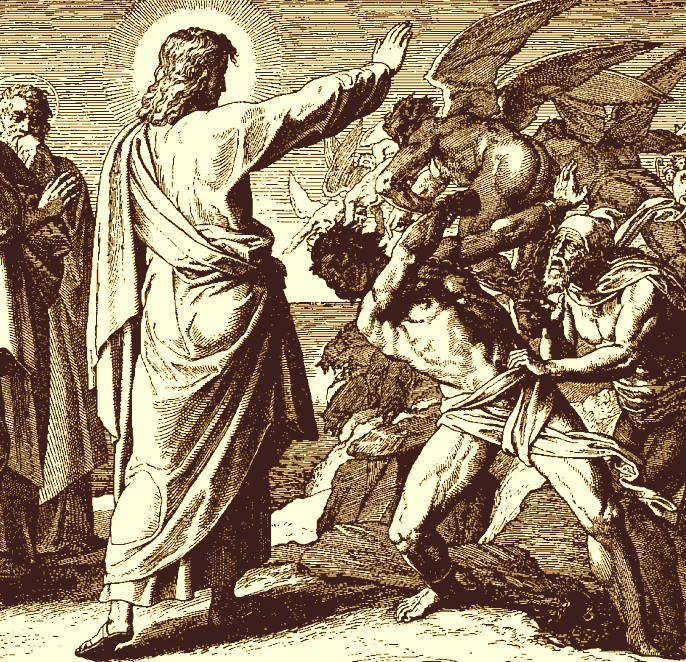
Based on Mark 1:21-28
Astonishing Authority
The people were astonished at his teaching,
Why?
for he taught them as one having authority and not as the scribes.
How did the scribes teach? The scribes taught referring to the authority of another. Their teaching always referenced a higher authority. They taught referring to scripture or, more often, referring to a revered rabbi and his commentary on a particular passage.
Jesus, however, does not do this. He does not appeal to another or higher authority. He teaches as one who is of the highest authority. He teaches as the highest authority. When He does refer to another it is usually like this, “You have heard it said…but I say…“
This is why the people were “astonished”. This word “astonished” shouldn’t be read as mere amazement or wonder. Rather, it should be read by us today as, “The people were shocked! The people were aghast! The people were uncomfortable! The people were taken aback and slightly scandalized!“
Crackpot Preachers and Prophets
Plenty of other preachers, self-proclaimed prophets, and religious zealots roamed the area at the time of Jesus. The ancient historian, Josephus, tells us that:
During the period when Fadus was proconsul of Judaea, a certain imposter named Theudas persuaded the majority of the masses to take up their possessions and to follow him to the Jordan River. He stated that he was a prophet and that at his command the river would be parted and would provide them an easy passage. – Antiquities 20:97-98 / Acts 5:36
and
At this time there came to Jerusalem a man from Egypt who declared that he was a prophet and advised the mases of the common people to go out with him to the mountain called the Mount of Olives, which lies opposite the city…For he asserted that he wished to demonstrate from there that at his command Jerusalem’s walls would fall down, through which he promised to provide them and entrance to the city. – Antiquities 20:169-170
Theudas was captured by the Romans and beheaded. The Egyptian escaped but not before 400 of his followers were slaughtered.
It is no wonder then that both the civil authorities (Rome) and religious authorities (Pharisees) wanted these types of men removed, quickly and permanently. This should also give us new insight into the words of the high priest, Caiaphas, at the time of Jesus’ Passion:
…it is better for you that one man should die instead of the people, so that the whole nation may not perish. – John 11:50
Absolute Authority
However, Jesus was different. Not only did He teach under His own authority, His teaching was accompanied by true signs and miracles; healings of the blind, deaf, lepers, and crippled (sometimes from a great distance), multiplication of food, and even bringing the dead to life!
In today’s Gospel, the shock and concerned feeling of “is this another crackpot preacher” quickly turns to true amazement. Jesus doesn’t cast out the demons in the name of another. He doesn’t even call upon God! He simply speaks and they obey. They have no other choice.
All were amazed and asked one another, “What is this? A new teaching with authority. He commands even the unclean spirits and they obey him.” v. 27
Like the people of His time, Jesus’ words should often make us uncomfortable and even shock us. He came not to make us happy but to make us holy. He came to “Comfort the afflicted and afflict the comfortable.“(Peter Finley Dunne). Every word of His should shed light into our soul, speaking to the dark “demons” in the strongholds of our hearts – “Quiet! Come out of him(her)!”
That can only happen if we are diving into His words every day. (Here’s a helpful tool to learn how to do that.)
Join our Affiliate & Reward program to get awesome discounts on books, rosaries, chaplets, and more!




 James M. Hahn, Author