
2026 Book Review #1
I typically wait until the end of the year and post about all of the books I’ve read. You can find those lists here. However, I’ve decided to review the books as I finish them while the story is fresh in my mind. I’ll also compile a list at the end of the year.
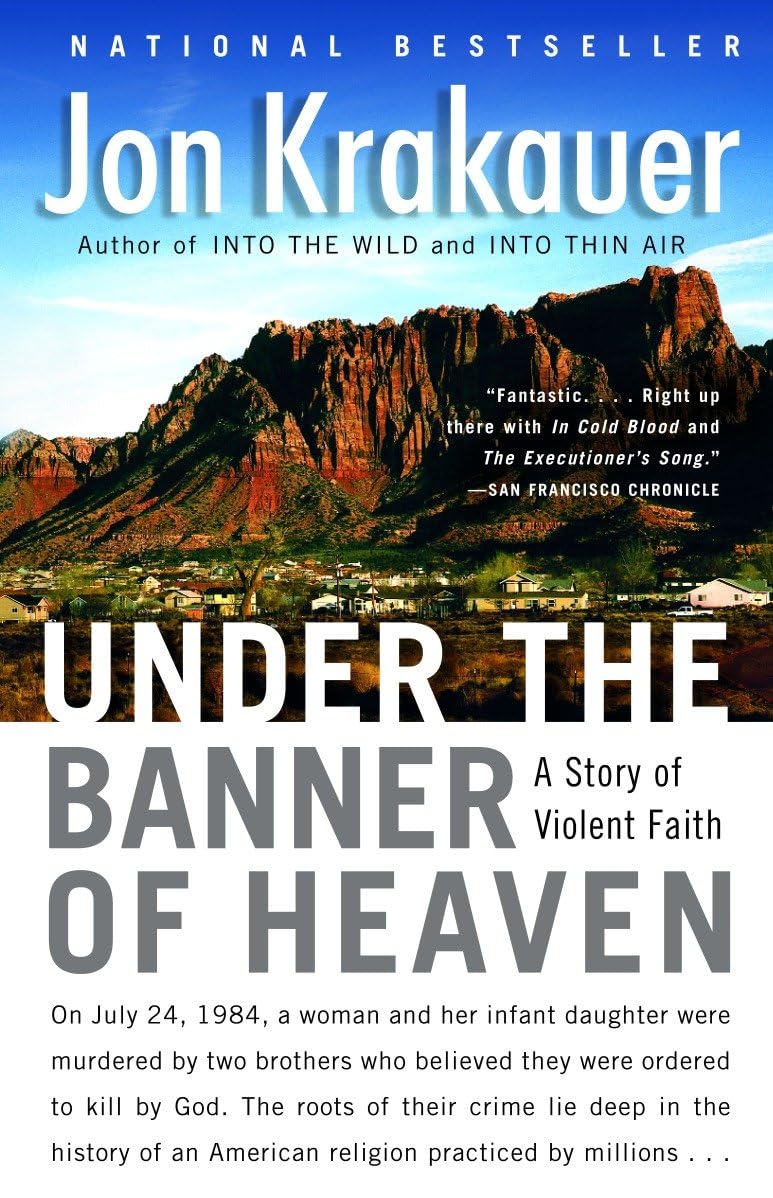
Disturbing, like watching a train wreck in slow motion and in all of it’s gory detail. This is how I would describe Under the Banner of Heaven: A Story of Violent Faith by Jon Krakauer.
As always, Krakauer does an excellent job presenting an extremely difficult, and in this case, very controversial topic.
The story focuses on the brutal murder of a woman and her 15 month-old daughter in 1984. However, Krakauer traces the origins of this violent act back through history to Joseph Smith, the founder of the Mormon (Latter Day Saints) Religion in 1830.
As a Catholic, I’ve never thought much about the Latter Day Saints. I assumed they were simply just another splinter Christian/Protestant group. I was wrong. This was not the introduction to Mormonism that I expected. From “angels” visiting Joseph Smith and telling him where to find a golden book, immediate splinter groups, plural/spiritual marriage (bigamy) to extreme violence, this book covers it all.
It’s a fascinating, riveting, and often times repulsive look at Mormonism throughout its relatively short and controversial history. I must admit that at one point in the book I found myself becoming physically ill as I listened to the detailed description of the 1984 murders as relayed by the murderer (the brother-in-law of the woman, the baby’s uncle – who is not remorseful, he still believes God instructed him to do it).
It truly was a book that I just couldn’t stop reading(listening). I’m not sure what that says about me.
Krakauer writes with a palpable disdain for religion. At the end of the book he willing admits that he is basically agnostic. I appreciate his honesty. His book, whether intentional or not, caused me to question my own beliefs. Why do I believe what I believe? Why do I believe my beliefs are true while others are obviously false? Many such questions arose in my heart after finishing the book.
As Catholics we are encouraged to question (something forbidden by many Mormon sects). An open, honest, inquisitive mind is often a path to God. As Blessed John Henry Newman wrote, “Ten thousand difficulties do not make one doubt.” A difficulty says, “how can this be” whereas a doubt says, “this can not be”.
A recurring thought while reading the book was, “these people, this entire thing is crazy, how can people even today believe this stuff.” Who in their right mind would believe an angel appeared to this petty swindler, Joseph Smith? Who would believe that this angel showed Smith a hill under which golden tablets were buried? Who would believe that these tablets came from some lost tribes of Israel that came to North America long ago?
When I distanced myself mentally from my own faith, I began with similar questions. Who would believe that God spoke through a burning bush to some fugitive-murderer from Egypt? Who would believe that this same fugitive received written commandments from God, on a hill/mountain? Who would believe a virgin gave birth to God? Who would believe that bread and wine become the Body, Blood, Soul & Divinity of that same God born of the Virgin?
I can sympathize with the modern skeptic and atheist when they too say, “these people, this entire thing is crazy, how can people even today believe this stuff.“
So, what makes me think that my Catholic Christian faith is correct and all others are misguided? With 2000+ years of human experience, my faith has a well-rounded world view. More importantly, it has a view of human life that simply makes sense. If all religions are simply man-made (which I don’t believe), only Catholicism presents a coherent philosophy of human existence. It alone has answers that “ring true”. This is not to say that these answers are easy and always provide comfort and peace, in fact is it is often quite the opposite.
“The Christian ideal has not been tried and found wanting; it has been found difficult and left untried.” – G. K. Chesterton – What’s Wrong With the World
We do not really want a religion that is right where we are right. We want a religion that is right where we are wrong. We do not want, as the newspapers say, a church that will move with the world. We want a church that will move the world. – G.K. Chesterton The Catholic Church and Conversion
While Krakauer’s book is engaging and fascinating, I am not blind to the fact that it does unduly present Mormonism in a negative light. A similar, and much larger, book could be written on Catholicism focusing only on negative events throughout history. However, there is a stark difference. Joseph Smith had a hired hitman to take care of those who opposed him, Jesus did not. Jesus rose from the dead. Joseph Smith did not. There were eyewitness accounts of the Resurrection and many of His followers willingly lost their lives rather than deny this truth, even to this day.
Ultimately, faith is a choice. We get to chose what we believe (I think this is just another way God respects our freewill). Yet, a true personal faith is one that asks, seeks, and knocks. It questions. It wrestles with God like Jacob, each and every day.
Was Joseph Smith a prophet, lunatic, or liar? Was Jesus the Lord, lunatic, or liar? A helpful book for examining this question, at least concerning Jesus, and by extension Joseph Smith and others, is Between Heaven and Hell: A Dialog Somewhere Beyond Death with John F. Kennedy, C. S. Lewis & Aldous Huxley by Peter Kreeft. Another would be C.S. Lewis’ Mere Christianity.
Under the Banner of Heaven: A Story of Violent Faith is fascinating, fast paced, and disturbing. I highly recommend this book but with caution. It is not for the faint of heart or squeamish. No punches are pulled. You will feel like you just went 12 rounds with Mike Tyson by the end but it’s worth it.


 James M. Hahn, Author