
(This is one of a series of 6 posts, if you missed any, you can start here)
Step #3 – Join the Story
The next step is to use your Christian imagination and place yourself in the story. Many folks think that we shouldn’t have a Christian imagination. I’m glad Michelangelo didn’t think that way. I’m glad Caravaggio didn’t think that way. I’m glad Michael O’Brien and Gina Switzer don’t think that way. God gave us an imagination and he wants us to use it. God has an awesome imagination. He’s the one who creates beauty, danger, cold, fire, scents, sounds, and yes, even mosquitoes. So here we need to imitate God and use our imagination.
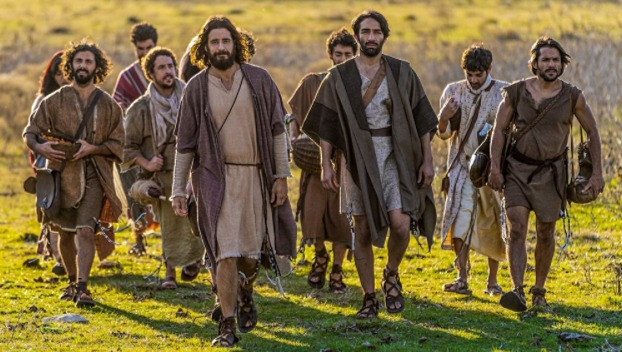
The easiest way to do this is to place ourselves within the scripture passage we are reading. Picture yourself first as a person in the crowd and reread the passage. Then picture yourself as a main character and reread the passage. Work to examine every part of the story from the various points of view depending on the story. What does Goliath look like to you as you, David, stroll out for battle and vice versa? What does the whole scene look like to you if you are Saul up on the hill? What‘s going through your mind as you allow this to happen? What is it like to be one of the followers of John the Baptist the day Jesus comes to be baptized? What is it like to be John? Is the water cold? What are the sounds, the sights? What do you see from the fish’s point of view or the birds? Maybe you came to the river to wash clothes and this event is taking place upstream.
The possibilities are endless when we use our imagination and become part of the story. That’s what stained glass, paintings, and statues were designed to do, bring us into the story. We have to regain that ability to use the Christian imagination in order to have more fruitful meditations. Don’t be afraid to try new angles or ideas. Maybe you are a donkey in the stable at Bethlehem. Maybe you are the serpent in the garden. The key is to continue the reading while examining the situation from every angle. Just as we examined the words with different emphasis, here we examine the scenery, the smells, the sights, the weather, the seasons, the noise, the silence, tumult, wind and waves, the nails, the thorns, the clothes or lack thereof. We examine every part we possibly can. Then and only then can we move on to the final step in this meditation process.
Need some more examples to help you get started? Here are some rosary meditations that really bring the Gospel to light by joining the stories as various people:
The Joyful Mysteries of the Rosary as seen through the eyes of St. Joseph
The Luminous Mysteries of the Rosary as seen through the eyes of Various People (St. James, a leper, a servant, St. Andrew, and even Judas).
Practical Steps
1. Review the Practical Steps for Steps 1 & 2
2. Place yourself in the Scripture as onlooker and as a participant.
3. Imagine the location, smells, sights, sounds. Let your imaginative senses come to life.
4. Try examining the scene from an angle you’ve never before considered.
5. Move on to the next step – Ask, Seek, Find!


 James M. Hahn, Author