
In recent days the eyes of the world have been fixed on Rome and the Roman Catholic Church. With the death of Pope Francis and the election of Pope Leo XIV, millions of people all over the world have watched this ancient Church, my Church, with all of her beauty, pageantry, and history on full display.
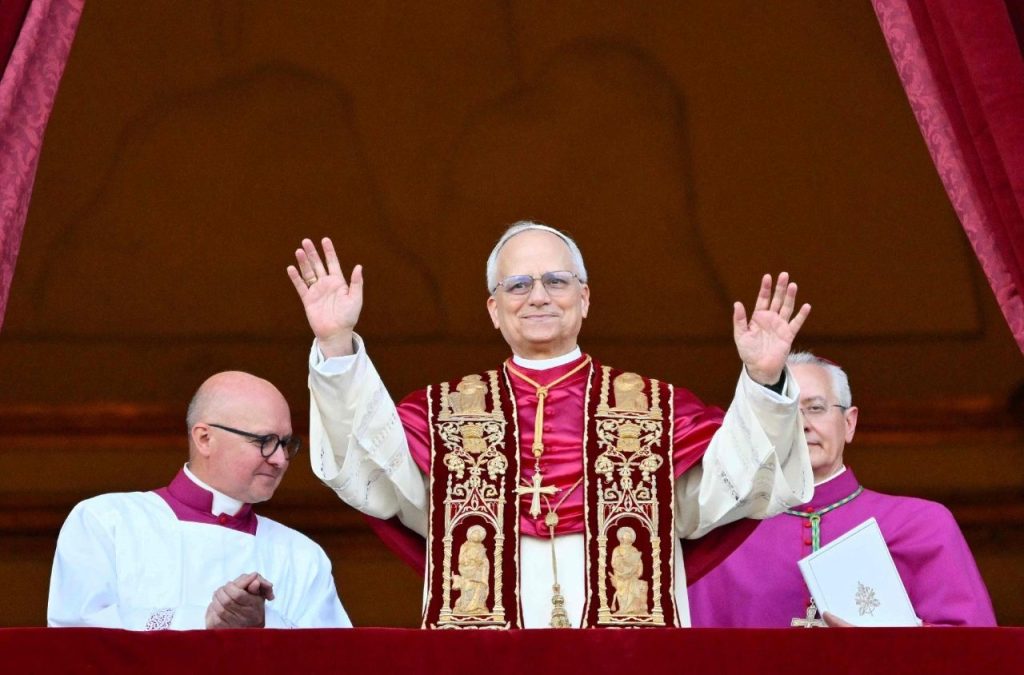
Why? What intrigues and fascinates people about our ancient Faith? Is it the beautifully orchestrated ceremonies and liturgies? Is it the ornate vestments or places of worship? Is it the rich, although often scandal-ridden, history? Is it a chance to peer back in time? Is it simply a welcome diversion to ordinary life? Is it an honest curiosity as to why this Church, this Faith, is so very different than all of the rest?
It is different, very different. Yet, regardless of all its “trappings”, inspiring architecture, 2000 years of history, thought, and science, there is one thing that makes it so very different that, “As a result of this, many [of] his disciples returned to their former way of life and no longer accompanied him.” (John 6:66)
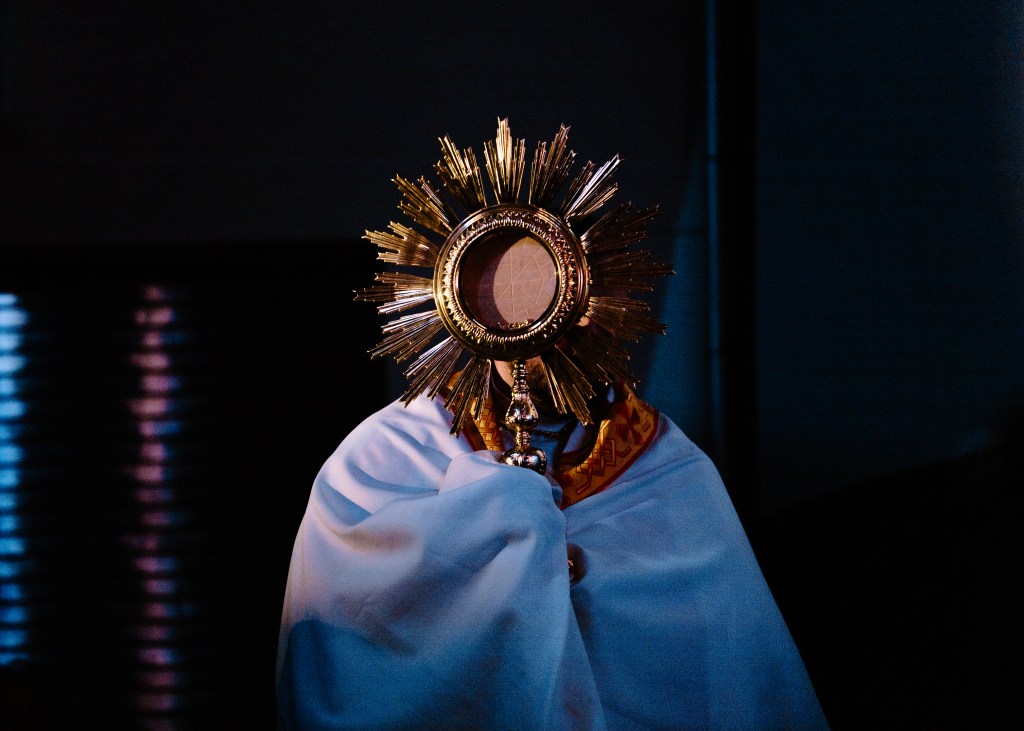
This, of course, is our belief in the Real Presence [of Jesus] in the Eucharist. To put it another way, we believe that the Eucharist is truly the Body, Blood, Soul, and Divinity of Jesus Christ. We believe that the little white host you see the priest lift up from the altar is truly Christ, the true Bread from Heaven. We believe, and have always believed this to be true. Saints have spilled ink and blood defending this truth. Men and women have died rather than deny this. Worldwide Eucharistic miracles (unable to be explained away by science) attest to this belief.
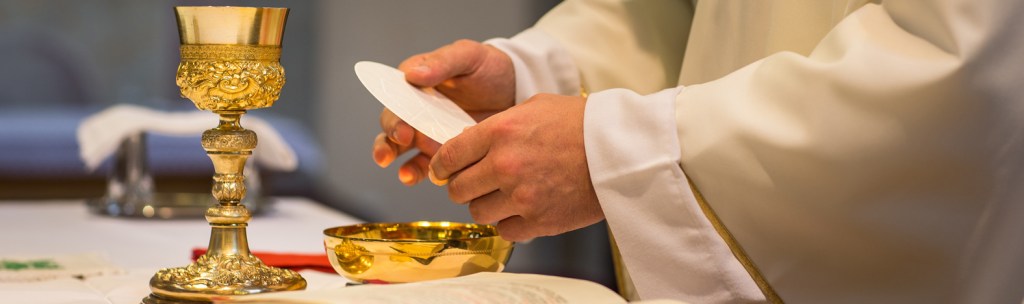
Why do we believe so strongly in the Eucharist? To put it simply, God said so. The same God who said, “Let there be light” and it happened, said, “This is my body” and it happened. He also said, “Do this in remembrance of me” and so we do. Additionally, there’s this:
“Amen, amen, I say to you, unless you eat the flesh of the Son of Man and drink his blood, you do not have life within you. Whoever eats (the word John uses means to gnaw or munch) my flesh and drinks my blood has eternal life, and I will raise him on the last day. For my flesh is true food, and my blood is true drink. Whoever eats my flesh and drinks my blood remains in me and I in him. Just as the living Father sent me and I have life because of the Father, so also the one who feeds on me will have life because of me. This is the bread that came down from heaven. Unlike your ancestors who ate and still died, whoever eats this bread will live forever.” (John 6:53-58)
But is this what He really meant? Couldn’t He have been speaking symbolically or metaphorically?
St. Paul answers,
“The cup of blessing that we bless, is it not a participation in the blood of Christ? The bread that we break, is it not a participation in the body of Christ?” (1 Corinthians 10:16)
“For I received from the Lord what I also handed on to you, that the Lord Jesus, on the night he was handed over, took bread, and, after he had given thanks, broke it and said, “This is my body that is for you. Do this in remembrance of me.” In the same way also the cup, after supper, saying, “This cup is the new covenant in my blood. Do this, as often as you drink it, in remembrance of me.” For as often as you eat this bread and drink the cup, you proclaim the death of the Lord until he comes. Therefore whoever eats the bread or drinks the cup of the Lord unworthily will have to answer for the body and blood of the Lord. A person should examine himself, and so eat the bread and drink the cup. For anyone who eats and drinks without discerning the body, eats and drinks judgment on himself.” (1 Corinthians 11: 23-29)
It doesn’t appear that St. Paul sees the Eucharist as symbolic at all! If it were merely symbolic or a memorial meal why would eating and drinking incur judgement? It is not symbolic. Neither St. Paul nor Jesus Himself tries to explain it away or make it easier to understand. In fact, Jesus allows His followers to leave Him over this issue (see John 6:66 above).
Again, this is a hard saying… One might reply that, “if I believed that, I would never leave the Church, literally. I would craw in on hands and knees and be there with the Lord for the rest of my earthly life.” While I understand the sentiment, it does not take into account temptation nor human frailty.
A similar sentiment is expressed by those who are “in love” and vow always to remain in love with their beloved. Time, temptation, and the world slowly work their way into the tiniest of gaps in that love and over time widen and widen the distance between the lovers. Those who have been in love and are still in love will readily admit that keeping that gap as narrow as possible takes a tremendous amount of work and sacrifice. This is why wedding vows include mention of fidelity, sickness, bad times, etc., these are standard love-gap wideners.
Similarly, a relationship with Christ, especially Christ truly present in the Eucharist takes a tremendous amount of work and sacrifice. This relationship takes fidelity to Him over the cares of the world, sin, and selfishness. It takes loving Him even when you don’t feel like it. It takes sacrificing time, energy, other friendships, etc., to make the relationship work. So, the sentiment is noted, but not realistic. A relationship with the Eucharistic Lord requires the same effort as any human relationship to stay “in love” with Him.
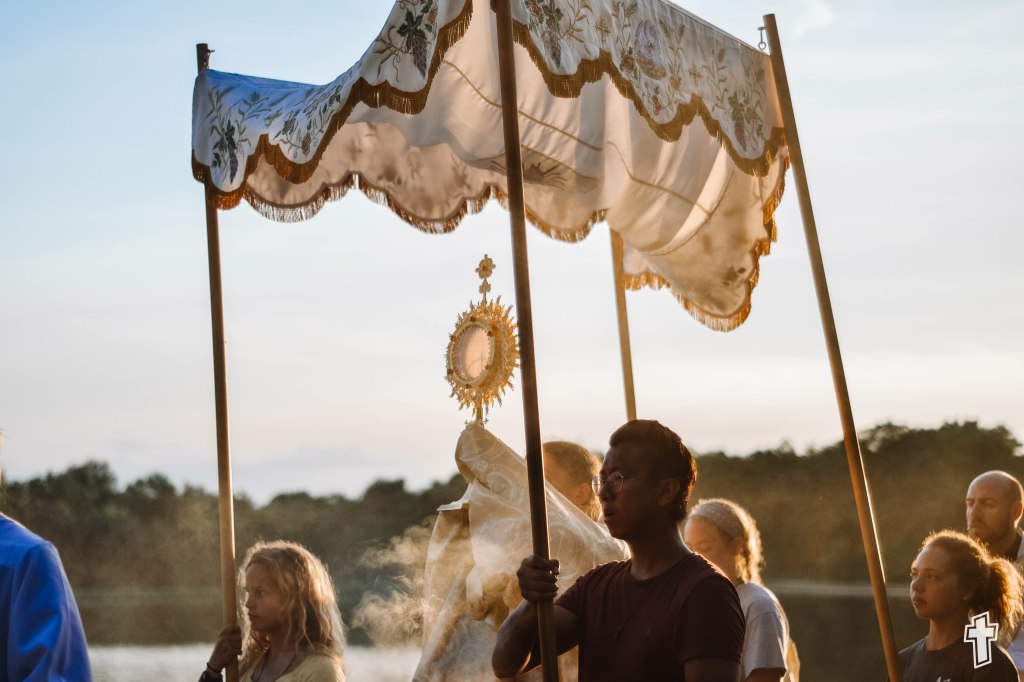
Catholics believe that Christ is truly present in the Eucharist at every Mass and in every tabernacle all over the world. The Mass is offered at every hour all over the world. At this very moment there is a Mass being offered; actually probably hundreds being offered at this very instant. We could truly say it is a perpetual sacrifice until the end of time. We “proclaim the death of the Lord until He comes again.”
THIS is what makes us different – the Eucharist. I have been to a Mass in a field with a million people. I have been to Mass on a mountain top with ten people. I have been to Mass in Basilicas and Cathedrals. I have been to Mass in my parent’s living room. All of the exterior show, beautiful or simple, is simply lagniappe. It is Jesus who I am there to receive and give myself to. It is Jesus who I am there to love and be loved by. In the end, for us Catholics, nothing else matters but Jesus Christ, the Risen Lord, the Lord of the Universe who comes to us under the appearance of simple bread and wine, humbly giving Himself so that we might live forever on the True Bread from Heaven.
If you would like to learn more about Catholic belief in the Eucharist, I highly recommend the following:
- Jesus and the Jewish Roots of the Eucharist by Dr. Brant Pitre
- The Fourth Cup: Unveiling the Mystery of the Last Supper and the Cross by Dr. Scott Hahn (no relation)
- Eucharist by Bishop Robert Barron


 James M. Hahn, Author