

Sacraments
If I recall my Baltimore Catechism correctly, a Sacrament is an outward sign instituted by Christ to give grace. This “outward sign” is something that impacts our senses. We can hear it, smell it, taste it, touch it, and/or see it. These signs are words, bread, wine, oil, and water. We believe that God uses these simple, humble gifts to bestow His life upon and in us. This is most often the way of God. He uses simple material objects to pour His divine life into us – words, bread, wine, mud, spittle, breath, or a touch. He uses humble little souls to teach us great lessons. He prefers the hidden to the ostentatious and the whisper to the storm; the healing and conversion of a heart to the visible healing of the body.
Yet, what if there were another sacrament that is so hidden, so humble, so gentle that it remains hidden to all but those who truly have the eyes to see and the ears to hear. This sacrament is before us at all times but we often ignore it. It’s taste can be bitter or sweet. It’s smell, fragrant or noxious. The sound of it can be melodious, disturbing, or inspiring. It’s touch can be soothing or excruciatingly painful. For those with eyes trained to see it, it is beautiful beyond words. For most it is invisible, unseen, and ignored. For some it is an inescapable terror.
The Hidden Sacrament
What is this “sacrament”? It is the Sacrament of the Moment. What does this mean? It is the outward signs given to us by Christ to give us grace – each and every moment of our lives. This sacrament is hidden in the fabric of our daily lives. It is the opportunity, given to us each second, to chose the Will of God; to say Amen! to the circumstances placed before us. It is the inexhaustible opportunity, while we live, to say, “not my will be done, but yours.”
Fr. Jean Pierre de Caussade, in Abandonment to Divine Providence, puts it this way,
“…If this be true, every moment of or lives may be a kind of communion with the divine love, and this communion of every moment may produce as much fruit in our souls as that which we receive in the Communion of the Body and Blood of the Son of God. This latter, it is true, is efficacious sacramentally which the former cannot be, but on the other hand, how much more frequently can it not be renewed, and what great increase of merit it can acquire by the more perfect dispositions with which it may be accomplished.”
In other words, the Sacrament of the Eucharist, while being full of infinite grace, may only be received once or twice per day. The sacrament of the moment, on the other hand, may be received, if we are properly disposed, at every second! We might add, how well are we truly disposed to receive the Body, Blood, Soul, and Divinity of Christ at each communion if we are not open to willingly accept God’s Will at every other moment of our lives?
Living the Sacrament of the Moment
How does this look in our daily life? It is living by Job’s words, “…Shall we receive good at the hand of God, and shall we not receive evil?” (Job 2:10) It is accepting God’s Will in every aspect of our lives at every moment. Those who have eyes to see and ears to hear do not ask, “why”. Rather, they say, “what are you trying to teach me, Lord? What lesson do I need to learn? Thy will be done.”
This sacrament of the moment may have the “outward sign” of joy or sorrow, abundance or loss, life or death, ecstasy or suffering. Either way, will we say Amen? Will we accept our situation, the outward signs instituted by Christ to give us grace – in that moment? Do we respond to an unexpected joyful phone call from an old friend and the frustrating breakdown of a needed vehicle equally? Do we accept the blessing of health or the pain of illness as God’s plan with a thankful heart? Do we bless the Lord and His providence during the birth of a child or the death of a loved one?
This is not to say that we should put on the cloak of a Stoic for even Our Lord showed great emotion at the death of Lazarus. Even Our Lord cried out for relief in His Agony in the Garden. However, He also set an example for living the sacrament of the moment when after crying out He says, “not my will but yours be done.”
This is how we are to live the sacrament of the moment; accepting God’s will at every moment of our lives. Yes, it is easier said than done. However, with practice, of which there is no little opportunity, we will discover this wonderful grace God wants to give us. Each moment of each day (and night) we have the chance to receive this sacrament and thus unending grace. Will you accept it? Will you willingly jump in line for this sacrament? If you say simply, “I’ll try”, you are already moving in the right direction.
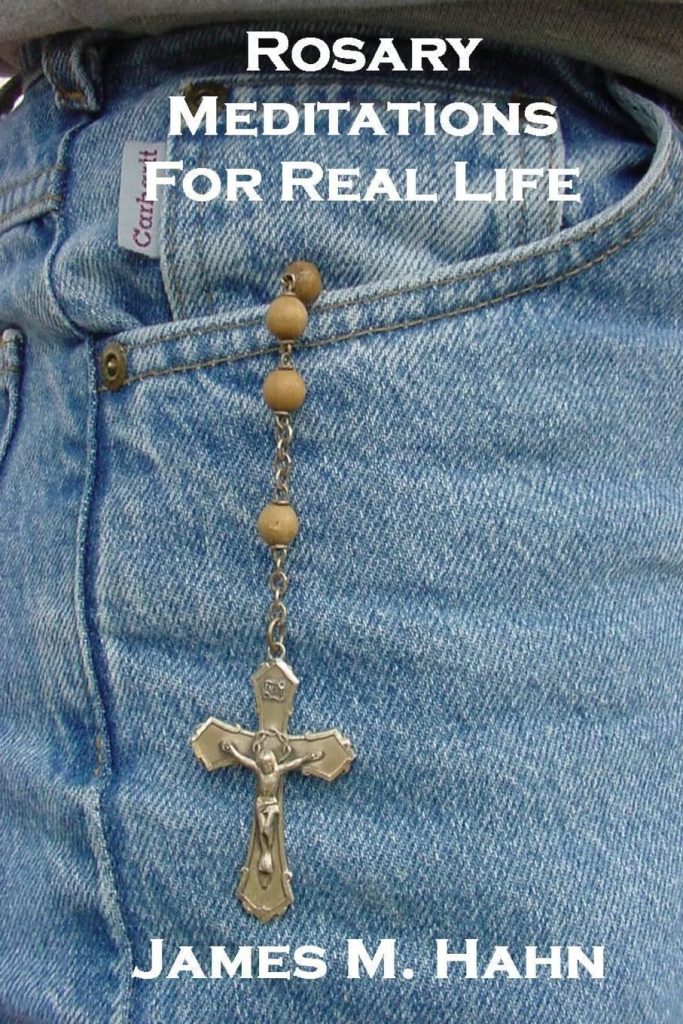
Rosary Meditations for Real Life
In Print for 22 years!!!
Here you will find the best rosary meditations to help you with everyday situations like Death, Addiction, Work, Family, Mass, and more
Here are some short rosary meditations PDF! (FREE)
Amazon – Paperback & Kindle


 James M. Hahn, Author